Electrical hardware lead · Dec 2025 – Apr 2026
Composite Filament Winder
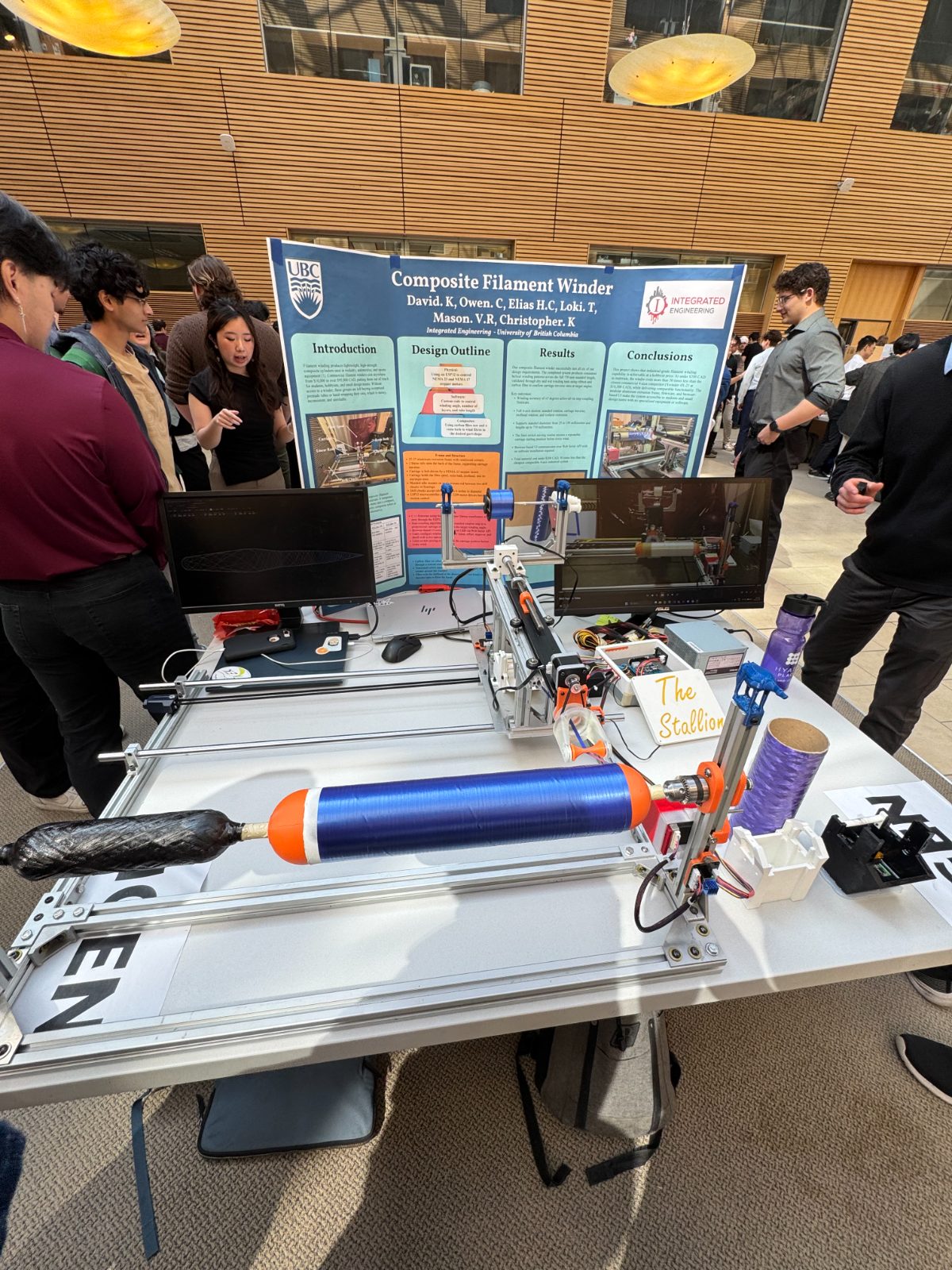
A low-cost 4-axis composite filament winder built to produce tubes up to 1 ft long and 6 in in outer diameter, holding ±1% winding angle accuracy. I was the electrical hardware lead on the build.
Axes
Four
Accuracy
±1% winding angle
Capacity
1 ft × 6 in OD tubes
My role
Electrical hardware lead
01 – Custom PCB
Single-board controller
I designed a custom PCB integrating the ESP32 microcontroller, four TMC2209 stepper drivers, power distribution, and signal routing onto a single board, replacing the breadboard prototype with a production-ready assembly.
The breadboard prototype was prone to intermittent connections. Consolidating power and signal onto one board made the machine's behaviour repeatable, which was necessary once we began validating the winding angle specification.
02 – Motion control
Motion hardware
Motion hardware is an ESP32 driving four TMC2209 drivers across two NEMA23 and two NEMA17 steppers. Limit switches handle axis homing and endpoint detection. I handled motor wiring, driver bring-up, and system debugging through to coordinated motion.
Controller
ESP32
Drivers
4 × TMC2209
Steppers
2 × NEMA23, 2 × NEMA17
Frame
Aluminum extrusion, custom mounting hardware
03 – Control software
Winding parameters and interface
I developed the C++ control software and a browser-based interface for the parameters that define a wind, which are tube length, winding angle, diameter, and layer count. From those inputs, the machine drives coordinated winding routines across all four axes, with real-time current and voltage monitoring during testing.
The interface is limited to those four inputs so an operator does not need to understand the axis coordination to run the machine.
04 – Assembly
Frame and assembly
I built and assembled the aluminum-extrusion frame and mounting hardware, integrating the motors, motion components, and the resin bath and toolhead into a single working machine.
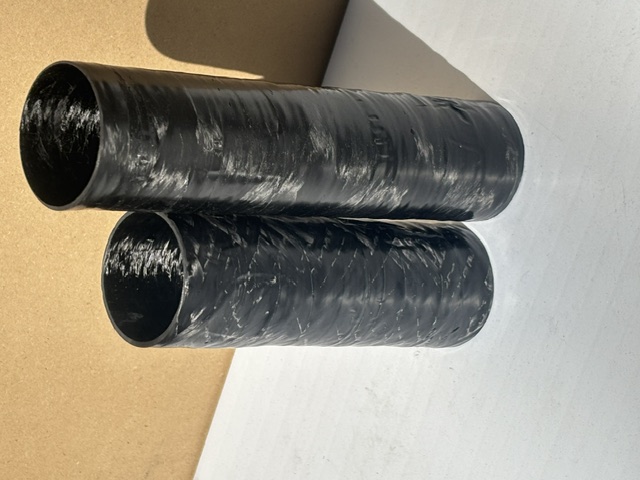
Two tubes wound on the finished machine.
Next: the cinewhoop drone.