Personal build · Apr 2026 – Present
Cinewhoop Drone
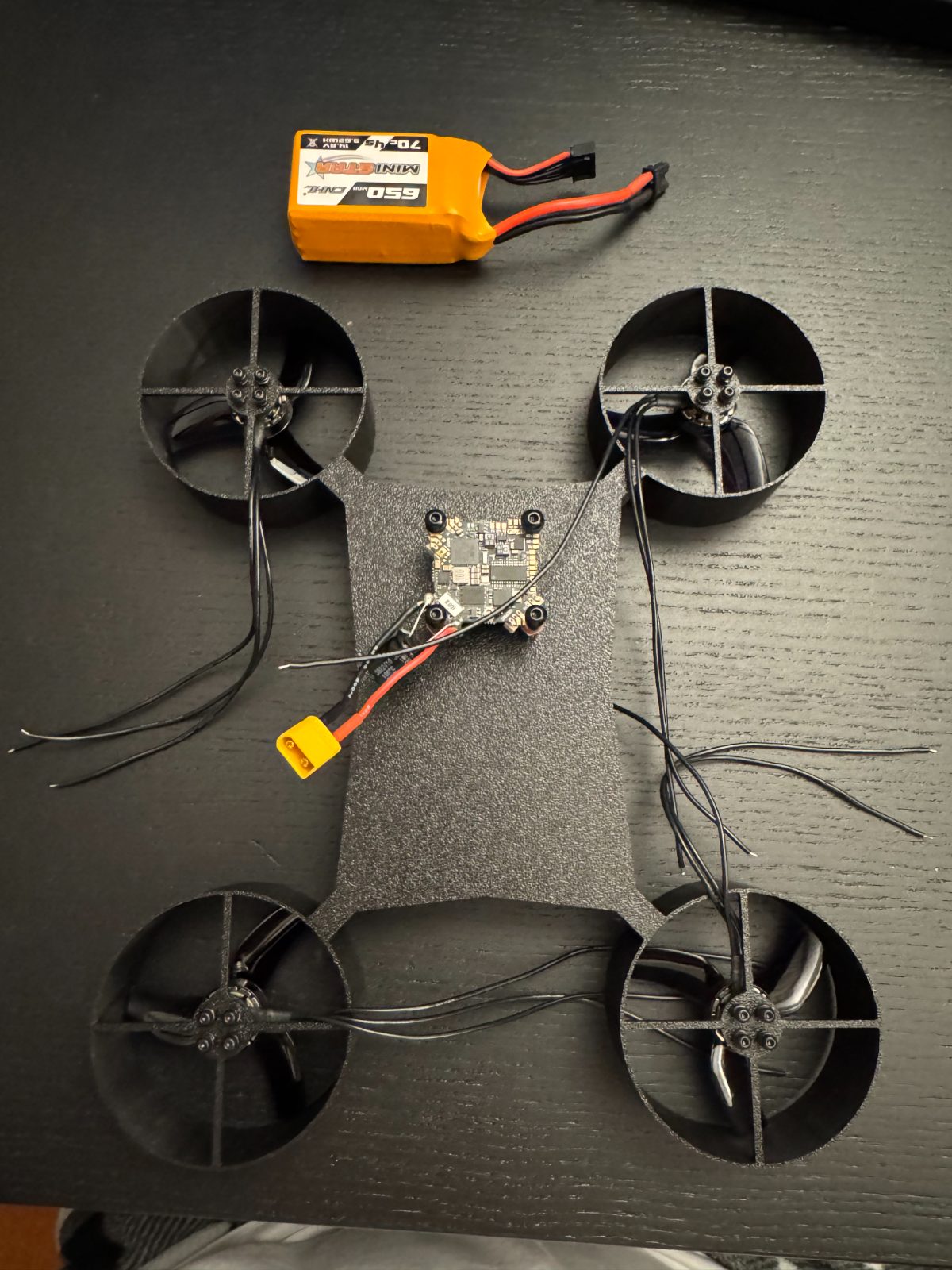
A custom 2.5-inch ducted quadcopter with a roughly 10-inch overall footprint, designed and built from scratch. The work covered frame CAD, electrical integration, soldering, and firmware bring-up.
Class
2.5″ ducted quad
Power
4S 14.8 V LiPo
Frame
Single-piece PLA print
Prototypes
Four
01 – Airframe
Single-piece printed airframe
The full airframe is modeled in SolidWorks as a single-piece printed frame integrating four ducts, motor mounts, and the top plate. Printing it as one piece removes fasteners and joints from the load path, at the cost of requiring every dimension to be correct before the print starts.
Four PLA prototypes were used to refine duct height, wall thickness, and motor stand-off geometry. Testing the prints identified wall flex, insufficient prop tip clearance, and stand-off heights that the CAD model did not predict.
02 – Electrical stack
4S power system and radio link
The stack runs on a 4S 14.8 V LiPo system built around a GEPRC TAKER F411 AIO flight controller with a built-in ELRS receiver, driving four 12 A ESCs, four GR1404 4500KV brushless motors, and Gemfan D63 tri-blade props.
Flight controller
GEPRC TAKER F411 AIO, built-in ELRS receiver
ESCs
4 × 12 A
Motors
4 × GR1404 4500KV brushless
Props
Gemfan D63 tri-blade
Battery
4S 14.8 V LiPo
03 – Bring-up
Soldering and first power-up
I soldered the XT30 power input, a 220 µF filter capacitor, and the motor phase leads directly to the flight controller. On continuity testing I found a solder bridge across the R001 current sense resistor and corrected it before applying power for the first time. Bench debugging of the electrical system was done with a multimeter and oscilloscope.
A shorted sense resistor would have damaged the board as soon as the battery was connected, so I now test continuity across every joint before applying power.
Next: the composite filament winder.